By: Aaron Wang
Taiwan (ROC or Republic of China), an island nation off of the coast of the People’s Republic of China (PRC), has been in the spotlight of an escalating geopolitical struggle. The United States, under incumbent President Biden, maintains a position of strategic ambiguity that leans more favorably towards Taiwanese independence, while the People’s Republic of China claims the island as its own (Brunnstrom, 2022). With coming elections, however, the stance of the US may change dramatically. While leaving US-Taiwan relations to the outcome of the US elections, it is imperative to analyze the history of the cross-strait relations between the PRC and the ROC.
Under Xi
President Xi Jinping (习近平), assumed office in 2013. Before taking the office of President, Xi was the General Secretary of the Chinese Communist Party (CCP) since 2012. Xi Jinping has maintained a similar approach to Taiwan as did his predecessors, which is a policy of claiming Taiwan as part of the PRC. The PRC has maintained the principle of “One China” when approaching Taiwan policy, which meant that Taiwan was not to gain independence and recognition from the international community. To achieve this aim, the PRC tried to exert diplomatic, economic, and now military pressure on the island nation (Huang, 2017).
Under Xi, however, cross-strait relations have stalemated if not deteriorated. In 2016, official channels of communications between the two governments were shut down and China began revamping their Taiwan policy without any consultation with Taiwan (He, 2020). This indicated that the PRC was increasingly viewing Taiwan’s cooperation as irrelevant, and that the struggle for reunification was solely the responsibility of the PRC, which led to more escalation and alienation of the two governments.
In 2014, Xi’s rhetoric took a sudden and harder stance on Taiwan, which proved to be counterproductive for the PRC’s aim of achieving reunification. In a statement, Xi declared that Taiwan could only engage with mainland China under the “One Country Two Systems” stance. This marked the point where the PRC aggressively demanded Taiwanese submission, which deviated from the 1992 agreement which declared that there is “one China, with different interpretations of what ‘one China’ signifies” (Cole, 2014). This policy shift was accompanied by a stronger sense of Taiwanese identity and disavowal of the PRC. From that point on, things spiraled downward, with no significant improvements in relations.
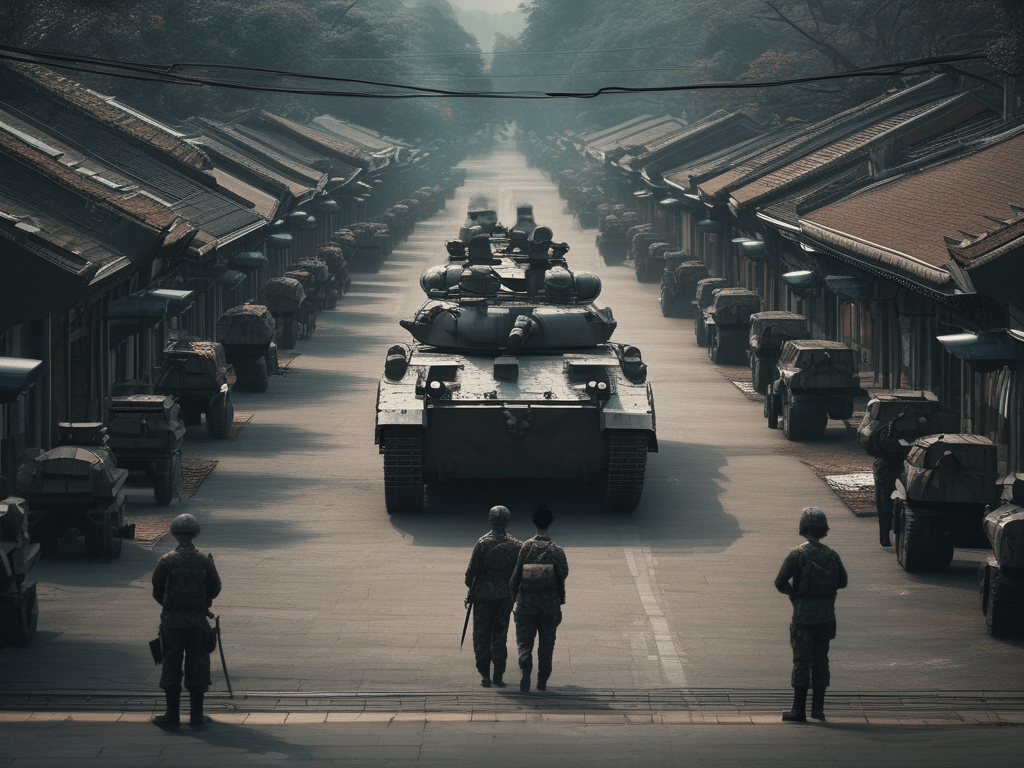
Relations further soured when Nancy Pelosi’s visited Taipei in 2022, which angered the PRC. The PRC promised to retaliate, and in doing so, launched large scale military drills surrounding Taiwan. These drills included, but are not limited to: amphibious landing simulations, air sorties, missile launches, and live fire exercises (Feng, 2024). This marked an unprecedented escalation, with the last military drills having occurred in 1995. Ever since 2022, military drills carried out by the PRC to provoke the ROC have become the norm, with almost daily sea and air patrols, and 1,714 violations of Taiwan’s air defense identification zone in 2023 (MDAA). The PRC even built a mockup of the Taiwanese presidential palace as a training site (Panella, 2024). As a result, Taiwan has been bolstering their military spending and preparing for invasion scenarios.
The narrative should be clearer now. Xi’s goal of reunification seemed to be consistent, but the way it’s being carried out has changed from a more peaceful approach to a more militarized approach over time.
The big picture
Relations are constantly in flux, with change occurring after most elections. Therefore, it’s also important to view the history of cross-strait relations holistically. The conflict began as a civil war between the CCP and the Kuomintang (KMT) during World War II. When Japan was defeated, the KMT was defeated and retreated to an island that we now know as Taiwan. Under Mao, the newly created PRC was aggressive towards Taiwan, with fire being constantly traded. However, the US threw its support for the ROC, which was based in Taiwan. As a result, Taiwan gained recognition in the international community. However that changed in 1979 when the US broke off official diplomatic relations with the ROC and began engaging more with the PRC. With that engagement came economic growth for the PRC. Soon, the PRC became a formidable economic power that had more leverage and resources to actualize the goal of reunification. As a result, more diplomatic and economic incentives and pressures were placed on Taiwan, with only one military escalation in 1995 that was immediately stopped.
From a less detailed but more holistic point of view, the PRC’s stance on Taiwan has developed in tandem with its economic power. With more economic power came more economic and diplomatic pressure and less military engagement. In the case of the early and unstable days of the PRC, military engagement was the main option to take towards Taiwan. However, the situation has recently started to change, with a more militaristic approach despite the PRC’s economic might. The PRC may have finally started to run out of patience.
Works cited
Brunnstrom, David, and Trevor Hunnicut. “Biden says U.S. forces would defend Taiwan in the event of a Chinese invasion” Reuters, 19 September 2022, https://www.reuters.com/world/biden-says-us-forces-would-defend-taiwan- event-chinese-invasion-2022-09-18/. Accessed 8 August 2024.
Cole, J. Michael. “Xi Jinping Turns the Screws on Taiwan”. The Diplomat, 29 October 2014, https://thediplomat.com/2014/10/xi-jinping-turns-the-screws-on-taiwan/. Accessed 8 August 2024.
Feng, Emily. “China launches military drills surrounding Taiwan”. National Public Radio, 23 May 2024, https://www.npr.org/2024/05/22/g-s1-138/china-launches-military-drills-surrounding- taiwan#:~:text=China%20first%20launchedmilitary%20drills,Taipei%2C%20much%20to%20China’s%20ire.. Accessed 8 August 2024.
He, Xuan. “Change in Taiwan policy under Xi Jinping administration: an internalized policy-making process.” Journal of Contemporary East Asia Studies, 18 December 2020, https://doi.org/10.1080/224761028.2020.1853313. Accessed August 8 2024.
Huang, Jing. “Xi Jinping’s Taiwan Policy: Boxing Taiwan In with the One-China Framework.” Taiwan and China: Fitful Embrace, edited by Lowell Dittmer, 1st ed., University of California Press, 2017, pp. 239–48. JSTOR, http:// www.jstor.org/stable/10.1525/j.ctt1w76wpm.16. Accessed 9 Aug. 2024.
MDAA, Taiwan Incursion Updates – Missile Defense Advocacy Alliance. missiledefenseadvocacy.org/missile-threat-and-proliferation/todays-missile-threat/taiwan-missile-updates. Accessed 8 August 2024.
Panella, Chris. “China Built a Mock-up of Key Area in Taiwan’s Capital City at a Desert Training Site, Satellite Images Show.” Business Insider, Business Insider, 28 Mar. 2024, www.businessinsider.com/china-built-mock-up- taiwans-presidential-office-area-desert-images-2024-3.
 ABTaiwanProject
Leave a comment