By: Erin Wong
Amid geopolitical tensions in the South China Sea and Taiwan’s increasing prominence in global politics, the nation’s long-term “health” must be considered. Namely, as Taiwan has become a key player in the semiconductor industry, the stakes are much higher. With advanced hardware paving the path for greater computational strength and data processing, the future of Taiwan must be assessed.
In the long term, assuming no interference from the PRC, Taiwan’s technological prowess depends on the strength of its human capital. At the core of human capital lies the education of its children—an essential factor in ensuring Taiwan’s continued growth and competitiveness on the global stage. Let’s dive into this subject.
Taiwan’s Growing Role in Global Politics
Taiwan’s strategic positioning during the rise of AI, heralded by the popularization of Chat GPT, has put itself in a precarious position, now producing 68% of the world’s share of semiconductors with a controlling share of 90% vis-à-vis advanced semiconductors.
Taiwan is at the forefront of global technology and has gained significant influence in the realms of artificial intelligence, data processing, and high-performance computing. Additionally, with US markets placing a humongous bet of capital into AI, instability in Taiwan’s future or supply lines could spell disaster for the market hype going on regarding AI.
Taiwan is a critical part of the supply chain for the crucial semiconductor chip. However, increasing geopolitical importance also places immense pressure on Taiwan to maintain its edge. The eyes of many nations are on Taiwan for any gaps in supply chain stability or disruptions. Taiwan must ensure its stability. One step is its people.
The Importance of Primary Education
The foundation of any nation is its people, and Taiwan is no exception. Especially as Taiwan is experiencing accelerated aging, the future of its people, specifically children and young people, are of utmost importance.
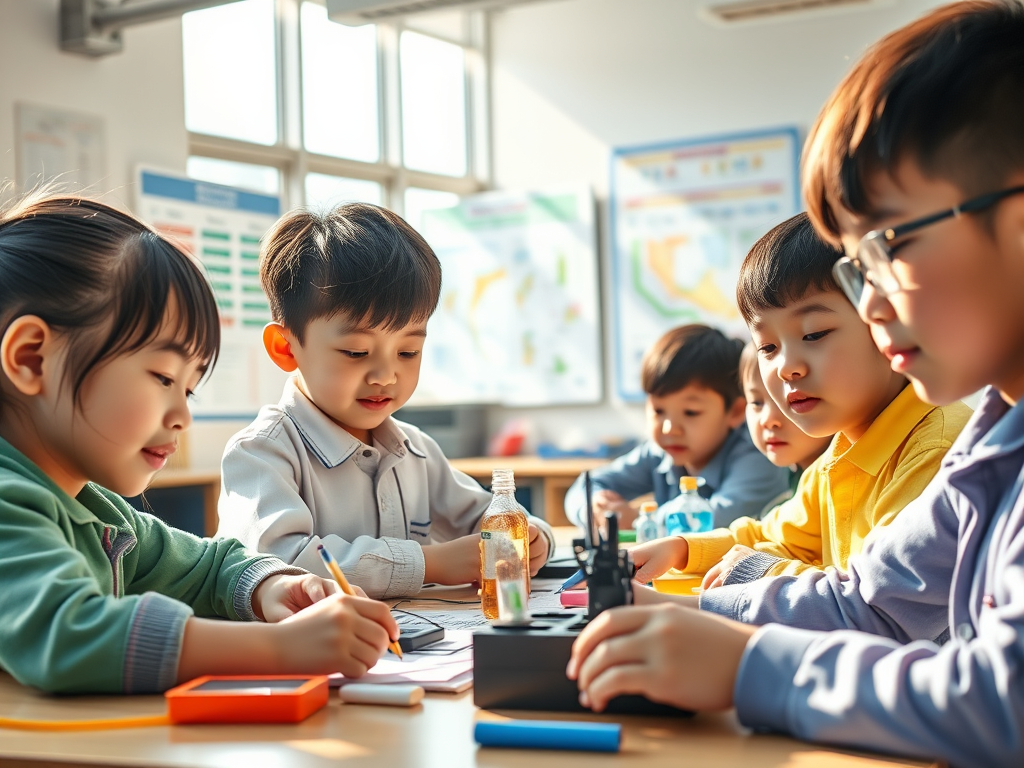
The early years of a child’s education are critical. They set the stage for cognitive development, their future work ethic, subject interests, or degree of engagement in learning. In an era where not only does Taiwan’s national security rely on these semiconductors but the world as well, STEM education becomes more important than ever. While Taiwan can outsource as well, its main source of workforce should be its own locals. The stakes have never been so high.
How does Taiwan’s primary education system work?
Primary education starts with an optional preschool, which is the equivalent to the US kindergarten. After that, there are 12 years of mandatory learning, which is similar to US educational standards. However, there are major differences and advantages that Taiwan enjoys. The focus of this article is on the subject matters of math and science because these subjects are critical for advancements in the semiconductor industry.
Specifically, Taiwan’s math and science curriculum is much more rigorous and challenging compared to the US counterpart. Partly, this is because the average age that students get exposed to challenging materials is much younger than the average age in the US that students get exposed to material like Taiwan’s. For example, students in Taiwan get exposed to more complex and algebraic thinking earlier than those in the US. That way, analytic ways of thinking are molded into the mind at an earlier and important age for learning. Additionally, in the early stages of education, the instruction is primarily lecture based, additionally strengthening pupils for their future to explore.
Additionally, Taiwan puts in much more sweat and tears, and they get results as a reward. With a significantly heavier workload and harder and more prevalent standardized testing, students and Taiwan as a nation consistently get results. These students also take their workload extremely seriously, with cram schools being especially commonplace.
Another differentiating feature is culture. In regard to STEM, and especially math, math contests and Olympiad training is viewed as nerdy and niche for many people in the US (at least in my experience), but in Taiwan, it’s a common and encouraged thing to do.
Taiwan has put its foot down on the question of education and analytical skills, and it has truly paid off, not only by offering a silicon shield to offer incentives to the international community to protect Taiwan, but it props up the economy and make the Taiwanese people known and valued.
Challenges and Opportunities in Taiwan’s Education System
While Taiwan’s education system has earned its place for its rigor and high performance in assessments like the Programme for International Student Assessment (PISA), there are challenges that must be addressed to completely secure the nation’s future. These include:
Creativity and Critical Thinking: Taiwan’s emphasis on strict memorization and standardized testing, though effective for producing high academic achievers, stifles creativity and independent thinking. While memorization and hard practice is important, creative thinking, built on the foundation of good academics, is key to truly advancing change.
Urban-Rural Disparity: As Taiwan continues to develop, the gap between urban and rural education has become clearer. Ensuring that children in rural areas have access to quality education and technology is important to creating a level playing field for all students and tap untapped potential to advance Taiwan as a whole.
Language and Global Connectivity: As Taiwan becomes more integrated into the global world, proficiency in languages such as English, is vital. While Taiwan has made the initiative to become largely bilingual by 2030, students need to truly understand the importance of learning the language.
Taiwan’s Strategic Investments in Education
Recognizing the importance of its human capital, Taiwan has made significant strides in reforming its education system. The government has implemented a number of initiatives aimed at improving the quality of education, such as promoting STEAM (Science, Technology, Engineering, Arts, and Mathematics) programs and integrating technology into classrooms. Additionally, there is a growing emphasis on cultivating soft and people skills, such as communication, collaboration, and adaptability—skills that will be essential in Taiwan’s future knowledge-based economy.
Conclusion
Taiwan’s future is tied to the education of its children. As the island nation continues to assert itself as a global leader in technology and innovation, it must ensure that its education system evolves to meet the demands of a rapidly changing world, not only to grow, but to ensure its security. With the right investment and strategic reforms, Taiwan’s primary education system will serve as a strong foundation for the nation’s future growth and global competitiveness.
 ABTaiwanProject
Leave a comment