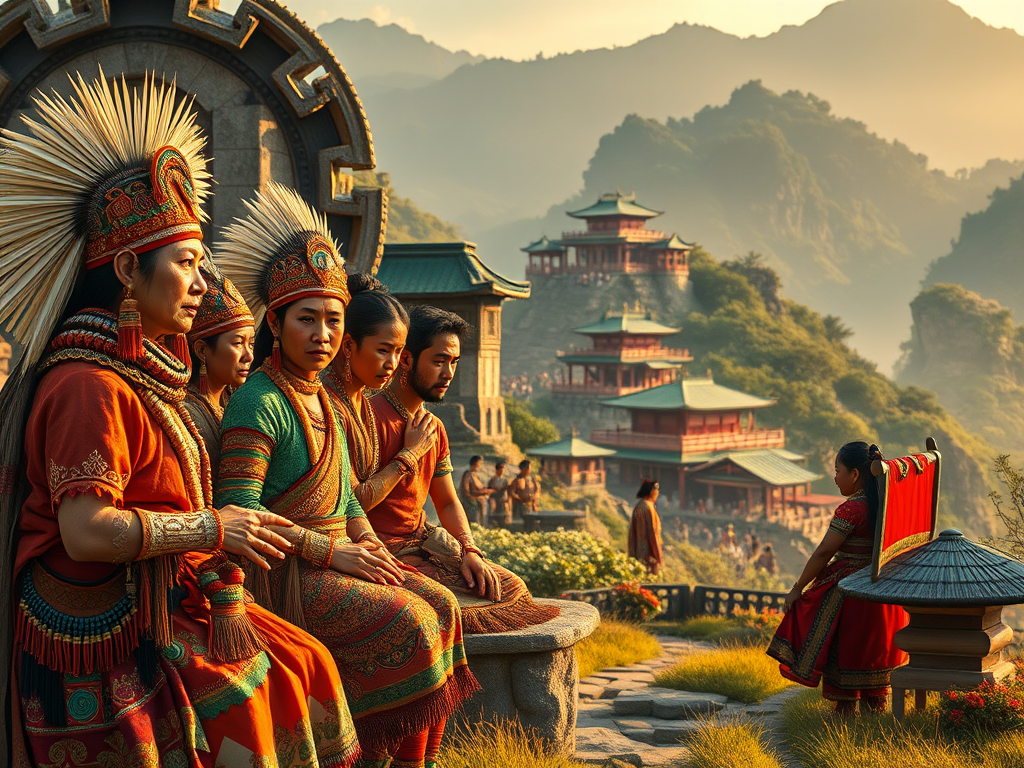
For most of Taiwan’s modern history, the story of national identity has been framed by its contests with great powers — from Dutch merchants to Japanese colonizers to Cold War geopolitics. Yet long before empire came to Taiwan’s shores, the island was home to Austronesian-speaking Indigenous peoples whose traditions and experiences remain critical to Taiwan’s democratic project today. To understand the pressures Taiwan now faces, it is essential to recognize how Indigenous identity was shaped by empire and how those lessons inform Taiwan’s path forward.
Archaeological and linguistic research places Taiwan at the heart of the Austronesian expansion, a maritime migration that spread from Taiwan across the Pacific and Indian Oceans thousands of years ago (Bellwood & Dizon, 2005). Indigenous Taiwanese groups, including the Amis, Paiwan, Atayal, and others, developed distinct social structures, oral traditions, and practices tied deeply to the island’s mountains and coasts (Shepherd, 1993). Before foreign powers arrived, these societies maintained autonomy and diversity, though they were not isolated — trade networks connected Taiwan to Southeast Asia and southern China (Rolett et al., 2002).
When the Dutch East India Company established Fort Zeelandia in 1624, it marked the first sustained encounter between Taiwan’s Indigenous peoples and a European empire. The Dutch sought to control trade, convert Indigenous groups to Christianity, and recruit them as laborers, often through coercion (Andrade, 2008). The Spanish briefly established a foothold in northern Taiwan, but their influence waned quickly.
The more enduring transformation came with Han Chinese migration. While Indigenous groups had long resisted encroachment, successive waves of settlers began to push Indigenous peoples inland, disrupting traditional lifeways. By the Qing Dynasty, Indigenous communities were divided into “raw” and “cooked” categories, with assimilation policies that erased cultural autonomy (Shepherd, 1993).
When Japan colonized Taiwan in 1895, its officials sought to manage Indigenous groups through both suppression and incorporation. Large-scale military campaigns were launched against the Atayal, Bunun, and other mountain peoples, whose resistance posed challenges to Japanese infrastructure projects (Ching, 2001). Yet Japan also pursued assimilation through education, policing, and economic integration.
This dual strategy of violence and forced modernization produced a complex legacy. For some Indigenous communities, Japanese rule brought schools, roads, and medical care, though often in ways that dismantled local autonomy. For others, it reinforced structural marginalization. Importantly, these policies created a template that later governments — including the KMT — would replicate, privileging “modernization” over Indigenous self-determination (Simon, 2010).
Today, Taiwan recognizes 16 Indigenous groups, and the constitution affirms their cultural and political rights. Yet challenges remain: Indigenous communities face economic disparities, environmental exploitation of their ancestral lands, and cultural erasure through Mandarin-dominated education (Stainton, 1999). Still, Indigenous activism has grown, demanding truth-telling about Taiwan’s colonial past and recognition of sovereignty claims. This activism is not just about history. It is about Taiwan’s democratic identity. As Taiwan projects itself as a vibrant democracy distinct from Mainland China, it must also reconcile with how Indigenous peoples have been marginalized across centuries of changing empires.
Taiwan’s Indigenous history is not a relic but a living dimension of its identity. The island’s encounters with empire did not erase Indigenous traditions; they transformed them into sources of resilience. As Taiwan asserts itself on the global stage, it must recognize that its strength lies not only in modern democracy but also in the diverse voices that have endured every wave of empire. Protecting Indigenous rights today is not only a matter of justice, it is a measure of Taiwan’s ability to define its identity on its own terms.
References
Andrade, T. (2008). How Taiwan became Chinese: Dutch, Spanish, and Han colonization in the seventeenth century. Columbia University Press.
Bellwood, P., & Dizon, E. (2005). Austronesian dispersals and the origins of Pacific peoples. Asian Perspectives, 44(2), 181–191.
Ching, L. T. S. (2001). Becoming “Japanese”: Colonial Taiwan and the politics of identity formation. University of California Press.
Rolett, B. V., Hung, H. C., & Carson, M. T. (2002). The prehistory of Taiwan: A synthesis. Asian Perspectives, 41(1), 1–26.
Shepherd, J. R. (1993). Statecraft and political economy on the Taiwan frontier, 1600–1800. Stanford University Press.
Simon, S. (2010). Tanners of Taiwan: Indigenous state relations in mountain indigenous society. Ethnology, 49(2), 95–112.
Stainton, M. (1999). The politics of Taiwan aboriginal origins. In M. Brown (Ed.), Negotiating ethnicities in China and Taiwan (pp. 27–46). University of California Press.
 ABTaiwanProject
Leave a comment