Amid Taiwan’s rising prominence in global politics—and its critical role in semiconductors, global supply chains, and regional security—looking back to its history offers key insights into its present strengths and vulnerabilities. The fifty years under Japanese colonial rule (1895–1945) left deep imprints on Taiwan’s identity, infrastructure, education, legal system, and social structure. To understand how Taiwan maintains its technological and economic edge—and what risks might threaten its future—we must examine what was built, what was suppressed, and what legacies remain.
Today, Taiwan is often discussed in terms of geostrategic necessity: its semiconductor dominance, its democratic model in an authoritarian region, and its indispensable role in East Asian and global economics. But behind that present lies a history that enabled many of the institutions and cultural dispositions that support Taiwan’s competitive edge. Japanese colonial rule was a major force in modernizing Taiwan—introducing infrastructure, legal frameworks, modes of education, public health, and administrative practices—that created a foundation for later growth. Yet those same colonial roots also introduced tensions in identity, culture, and politics, many of which still affect Taiwan’s cohesion and capacity for adaptive innovation.
Japanese colonial policy in Taiwan was not static over its fifty-year span; it evolved in response to local resistance, Japan’s imperial goals, and broader global pressures (Shirane, 2022). Several areas saw transformation that still echo today.
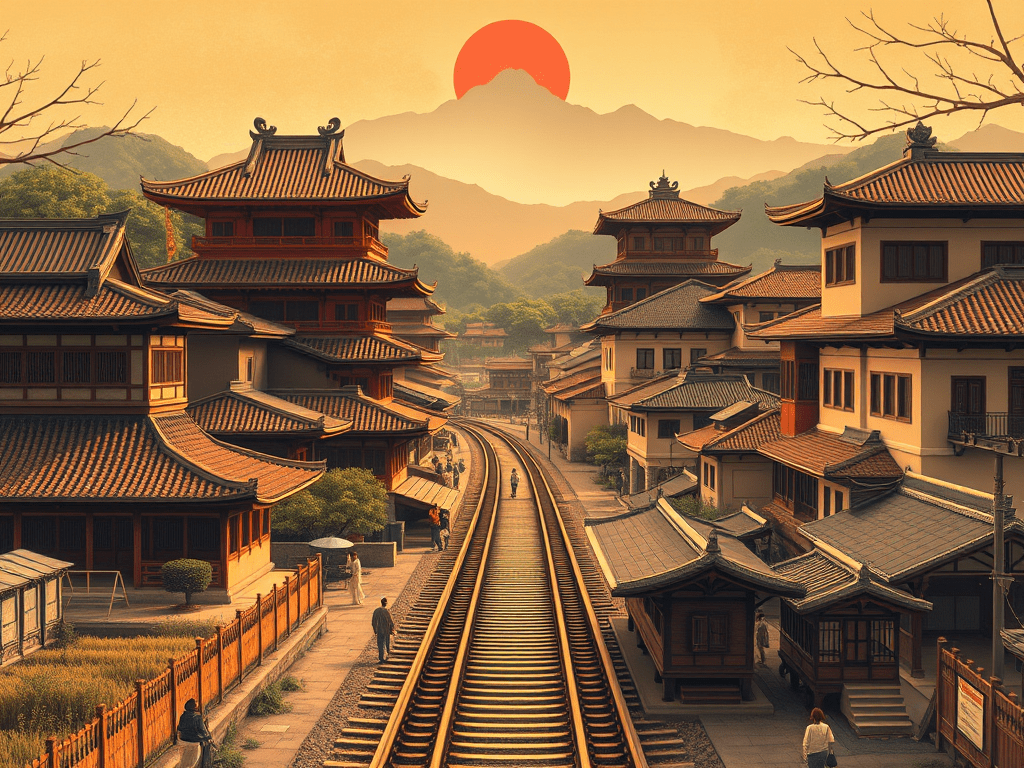
From the beginning, Japan pushed to make Taiwan a showcase colony. Taiwan Government-General invested heavily in transportation (railways, ports, roads), public utilities (electricity, sanitation), and agriculture—particularly rice and sugar production—using modern techniques and new strains (Britannica, n.d.). These investments transformed Taiwan’s economy from a primarily subsistence agricultural society into one connected to global markets. Electrification and industrial growth under Japanese rule laid groundwork for later industrialization.
Japanese rule also introduced modern systems of public health—eradicating diseases, improving sanitation, building hospitals—and legal reforms, including reception of Western law, codification, and bureaucratic administration. These legal and health systems helped reduce mortality and increased life expectancy, while the legal reforms provided stability, contract enforcement, property rights—all essential for the growth of commerce and technology sectors.
Perhaps most critical for human capital was the colonial education system. Japanese colonial administrators viewed education as a tool for assimilation: to instill loyalty to the Japanese empire, to teach Japanese language and culture, and to suppress or marginalize local languages and identities. Over time, the colonial government shifted its strategies—from excluding Taiwanese from high positions to more intensive “Japanization” or Kominka policies (1937-1945) that mandated Japanese in schools, encouraged cultural assimilation, and even sought ideological alignment.
The education system also served to raise literacy, standardize schooling, build institutions, and train professionals. That investment paid off in having a more educated populace at the end of colonial rule than might otherwise have been expected. While the colonial period brought modernization, it came with serious costs—especially in terms of identity, autonomy, and culture. For Taiwan to navigate its current trajectory, these fractures are as relevant as its structural assets.
Under Japanese rule, Taiwanese had almost no political power. They were excluded from high governmental positions; local self-rule was minimal or tightly controlled. Taiwanese languages, customs, religious practices and Chinese identity were discouraged. Chinese-language schools were often closed; the Japanese language was imposed in public, in education, and in administration. These policies generated resentment and resistance. Uprisings occurred throughout the colonial era. For example, among indigenous peoples, and Han Chinese communities, such as the Beipu Uprising (1907). The policies of assimilation under Kominka intensified these tensions.
Even as literacy and education rates rose, the opportunities provided by Japanese colonial institutions were not evenly distributed. Indigenous communities and those in mountainous or remote rural areas were especially marginalized. Though Japanese rule brought roads, schooling, and health care into previously intact indigenous zones, this was frequently done through coercion, forced relocation, or suppression of indigenous identity.
Similarly, access to higher education, administrative positions, and economic benefit was skewed toward Japanese colonists and Taiwanese elites who cooperated with the colonial structure. Class, ethnicity, and loyalty to Japanese norms influenced who benefited most.
Looking at the longer arc from the end of Japanese rule (1945), through KMT rule, martial law, democratic transition, and into the current era, we can trace how the colonial period both empowered and constrained Taiwan’s pathways.
The question of identity is deeply intertwined with how Japanese colonial rule is remembered—but also how it is taught. After 1945, Taiwan’s identity struggled among “Chinese,” “Japanese colonial,” and “Taiwanese” labels. Under KMT, Chinese nationalist identity was strongly promoted; only more recently has Taiwan developed more robust narratives that recognize its colonial past, its indigenous histories, and hybrid identities. Textbooks and teacher discourses have shifted over time for this reason.
The assimilationist legacy meant that certain ways of thinking—obedience, discipline, hierarchy—were reinforced, which had some positive effect in order and literacy—but sometimes at the cost of creativity, dissent, and local cultural diversity. Also, remote and indigenous communities remain underrepresented in higher levels of education, economic sectors, and in decision-making spheres—echoes of colonial-era inequalities.
Japanese colonial rule over Taiwan was a paradox of modernization and suppression, of infrastructure and identity erasure. Its legacies are deeply embedded in Taiwan’s legal, educational, infrastructural, and cultural systems. These legacies have given Taiwan much of what enables it to compete globally today: strong foundations in public health, rules of law, education, and modern infrastructure. But they also carry costs—in suppressed identity, in inequalities, in tensions of memory—that still require active reckoning.
For Taiwan’s future, assuming no external coercion, strengthening its identity with honesty about history, expanding inclusivity, and reforming education to encourage creativity alongside discipline are all essential. Taiwan’s colonial past isn’t just a stage that ended—but a set of structures and memories that continue to shape both its risks and its comparative advantages. How Taiwan interprets and reforms these inherited structures will play a major role in determining whether it continues to grow, adapt, and serve as a resilient actor in global politics.
References
Britannica. (n.d.). Taiwan as part of the Japanese empire. In Britannica. Retrieved from [Britannica website]
Encyclopedia Britannica
Shirane, S. (2022). Imperial Gateway: Colonial Taiwan and Japan’s Expansion in South China and Southeast Asia, 1895-1945.
The Asia-Pacific Journal
Tsurumi, E. P. (2008). Education and Assimilation in Taiwan under Japanese Rule, 1895–1945. Modern Asian Studies.
Cambridge University Press & Assessment
Peng, H.-S., & Chu, J.-Y. (2017). Japan’s colonial policies – from national assimilation to the Kominka Movement: a comparative study of primary education in Taiwan and Korea (1937-1945). Paedagogica Historica, 53(4), 441-459.
Taylor & Francis Online
Simon, S. (2025). Formosa’s First Nations and the Japanese: from colonial rule to postcolonial resistance. Asia-Pacific Journal: Japan Focus.
 ABTaiwanProject
Leave a comment