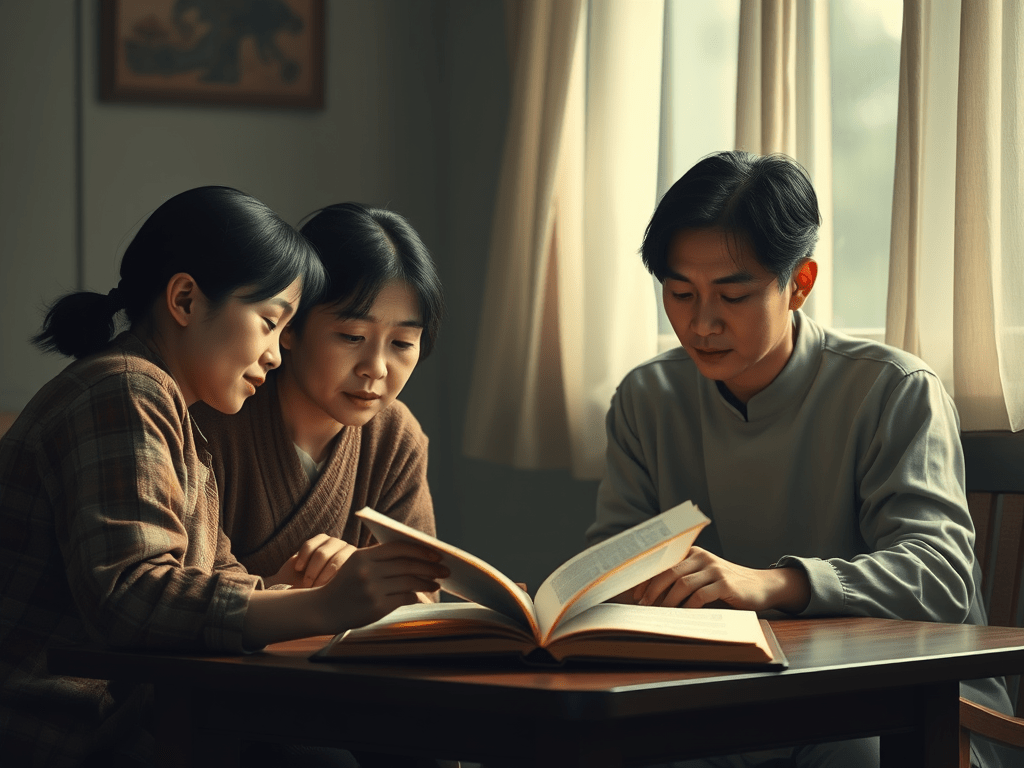
The memory of the White Terror didn’t end with martial law in 1987. It has become a central subject of Taiwanese literature and film, shaping both identity and political consciousness. While government repression silenced voices during the period itself, the lifting of censorship has allowed artists and writers to confront trauma and reconstruct history from the perspective of victims and their descendants.
Authors, such as Bo Yang and Chen Yingzhen, used fiction to expose authoritarian life under the White Terror. Their works often avoided direct confrontation with political censors, instead layering allegory and metaphor to portray repression. Later writers, freed from censorship, turned openly to the past. Wu Zhuoliu’s Orphan of Asia gained new resonance, while novels like The Fig Tree explored intergenerational memory of state violence. Stylistically, many of these works used fragmented narration and multiple voices, mirroring the silences and gaps left by political imprisonment. For ordinary readers, such literature allowed suppressed feelings of fear, shame, and resistance to surface in recognizable human form.
Film carried this memory to the public eye more visibly. Hou Hsiao-hsien’s A City of Sadness (1989) was the first major motion picture to depict the February 28 Incident and its aftermath. By portraying a single family fractured by political violence, it translated an abstract historical trauma into intimate, relatable loss. Edward Yang’s A Brighter Summer Day (1991) captured the anxieties of youth living under authoritarianism, showing how political repression seeped into the everyday. More recently, films like Formosa Betrayed (2009) and documentaries such as The Silent Era have continued this work, blending personal testimony with cinematic storytelling to ensure that the White Terror is not relegated to footnotes.
What makes these works powerful is not only their artistic merit but also their public function. Screenings of A City of Sadness often drew families who had never openly spoken about 1947 or the White Terror. Book clubs and classroom readings of politically charged novels have sparked intergenerational dialogue, giving younger generations a window into their grandparents’ unspoken fears. In this way, literature and film did not just record history — they reshaped the social fabric by inviting conversations that were impossible during martial law.
The memorialization of the White Terror through culture underscores how Taiwan confronts its past. State archives remain incomplete, but novels and films have filled those gaps with stories that are both personal and collective. Just as the Han Kuang drills test Taiwan’s readiness in the face of military threats, the ongoing cultural remembrance of the White Terror tests Taiwan’s readiness to reconcile with its own history.
The White Terror was once a silence forced upon society. Today, through the pages of novels and the images on screen, it has become a dialogue. Literature and film have taken what was once forbidden memory and transformed it into a shared story. For Taiwan, this cultural work is more than artistic expression — it is a rehearsal of democracy itself, proving that the freedom to remember is inseparable from the freedom to imagine a different future.
References
Hsia, C. T. (2015). A history of modern Chinese fiction. Indiana University Press.
Hsiau, A. C. (2000). Contemporary Taiwanese cultural nationalism. Routledge.
Yip, J. (2004). Constructing a nation: Taiwanese history and the films of Hou Hsiao-hsien. Post Script, 23(2), 82–97.
 ABTaiwanProject
Leave a comment