By: Aaron Wang
For the average civilian this year, boiling cross-strait tension has shown its face on the street. In July of 2025, amidst continued escalation of not only PRC rhetoric against Taiwan but also maneuvers in disputed seas like the South China Sea, Taiwan conducted its 41st annual Han Kuang (漢光演習) military drills. This time, the drill was the largest and most comprehensive of its kind. Spanning 10 days, the exercise tested resilience in real city scenarios, incorporated advanced U.S. military systems, and simulated realistic threat scenarios.The drill was not only in visible military deployments but also in reinforced urban defense measures and public engagement.
Background
Since the beginning of the Han Kuang drills in 1984, it has been Taiwan’s most visible annual war game. These drills are to assess the Republic of China’s (ROC) combat readiness against a potential People’s Liberation Army (PLA) invasion. Typically consisting of simulated war-gaming and followed by field training exercises , the Han Kuang exercises generally lasted around five days. However, the 2025 exercises broke from tradition and lasted 10 days with it being the most visible it’s ever been.
2025
This year (2025), the Han Kuang drills were expanded dramatically. The exercise began on July 9 and ran for 10 days and 9 nights, nearly doubling previous exercise durations. It mobilized a record 22,000 reservists and a wide range of military equipment. Additionally, the drills this year emphasized simulated assaults on command systems and infrastructure, honing in on Taiwan’s ability to operate under cyber and command disruption.
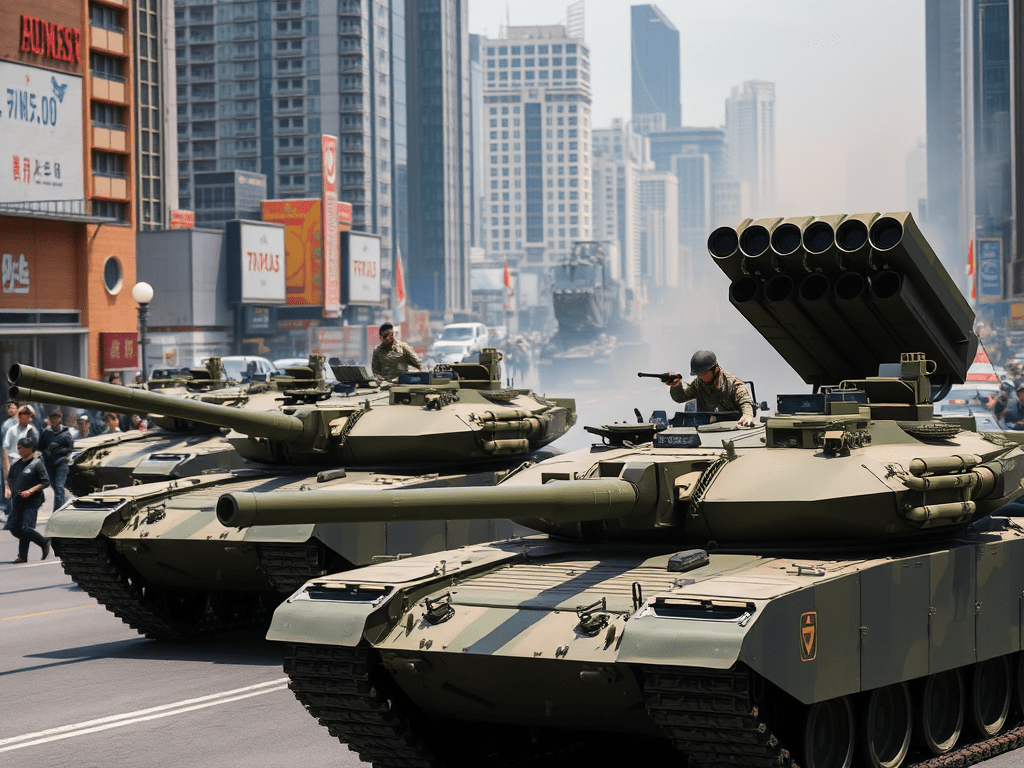
Importantly, advanced U.S. systems were displayed and deployed in a bid to show solidarity and integration with the west as demonstrated with U.S. made High Mobility Artillery Rocket System (HIMARS) rocket launchers making an appearance in Taichung on day four of the drills. Offering 300 km (186 mi) of operational range, Taiwan sought to display its capability to aim at strategic targets across the strait. Additionally, Taiwan’s new, U.S supplied M1A2T (Taiwan export version of the M1A2) Abrams tanks was also featured. While these drills were ongoing, President Lai Ching-te observed live-fire drills south of Taipei, where tanks conducted live fire against stationary and moving targets.
In the Taipei region, urban resilience and operations were spotlighted. Exercises and drills were simulated in urban areas to train soldiers in protracted urban warfare. In Penghu and Matsu, outlying islands near the coast of the PRC, military forces, including security and firefighting robots, simulated the defending of critical energy installations.
Civil transparency
Civilian participation was also another unique aspect of this year’s Han Kuang exercises. Around 100 training scenarios were publicly disclosed and many of them were actually held in civilian areas, allowing citizens to observe real-time and engage with defense preparations, thereby deepening public awareness, buy-in, and improving the military’s preparation for civilian-military interactions.
Additionally, these drills were unique in the sense that they integrated themselves with civil activities. For example, soldiers were spotted in subways and were filmed transporting equipment and weapons across metro (MRT) lines. Soldiers were even spotted transporting portable rocket launchers in trains. Furthermore, all traffic and activity in Taipei was shut down for around 30 minutes to clear streets for exercises and simulate disruptions due to a potential invasion.
Implications
The 2025 Han Kuang drills hold significance on multiple levels. First is regarding complex nation to nation interactions. Against a backdrop of rising PLA provocations, such as repeated incursions into Taiwan’s Air Defense Identification Zone (ADIZ) and export restrictions, the drills served to both warn Beijing as well as publicly affirm Taipei’s resolve to defend itself. Additionally, displays of U.S. weaponry underscored Taiwan’s increasing realignment with western powers.
The second regards domestic civil-military interactions. By bringing exercises into urban cores and enabling public access, Han Kuang blurred the lines between military readiness and civilian life, preparing society psychologically and operationally for potential crises. In fact, there has been a trend of psychological preparation, as illustrated in our analysis of a newly released movie called zero day.
The third area of significance concerns the uniquely modern demands of adapting to grey-zone threats. These threats, which deviate from conventional military threats, include maritime harassment, cyberattacks, misinformation, influence campaigns, and economic coercion. This year’s Han Kuang drills showed that Taiwan was working to address not only a full-scale invasion but also grey-zone threats that would precede kinetic warfare.
Conclusion
The 2025 Han Kuang drills were more than just a rehearsal of arms. They were a rehearsal of society itself. By stretching longer, digging deeper into the fabric of urban life, and pulling civilians into the theatre of defense, the drills turned the abstract possibility of invasion into a lived experience. For Taiwan, this meant projecting readiness not only outward but inward, into the daily rhythms of subways, streets, and neighborhoods. Against a volatile cross-strait backdrop, Han Kuang 2025 communicated a clear message: Taiwan stands united and ready.
 ABTaiwanProject
Leave a comment