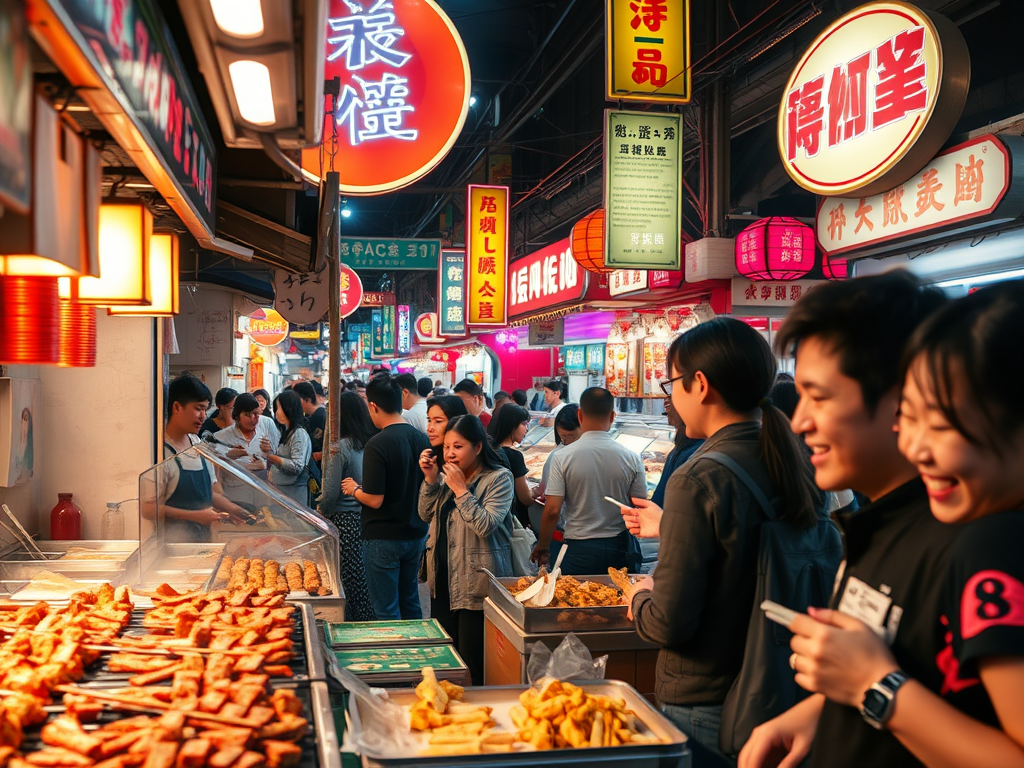
Walk into almost any Taiwanese night market and you feel it immediately—that rush of heat from a charcoal grill, the sing-song rhythm of hawkers, the slow tide of people drifting through alleys where every turn promises a new smell, a new bite, a new surprise. Today, this scene feels inseparable from Taiwanese identity. But night markets weren’t always neon-lit icons. Their origins are humbler, rooted in religion, migration, and the island’s constant ability to adapt.
Night markets first grew around temples during the Tang dynasty, when peddlers gathered at dusk to sell food and goods to workers visiting their local gods after dark. This rhythm carried into Taiwan, but the markets as we know them didn’t take shape until after World War II. The “Taiwan Economic Miracle” brought waves of new urban workers—many of them migrants—who needed cheap meals, a place to unwind, and a sense of community. Vendors responded with xiaochi (小吃): small, inexpensive dishes that felt like banquet food without banquet prices.
By the late 20th century, places like Shilin, Raohe, and Shida had become sprawling micro-economies. Shilin alone holds more than 500 stalls and draws locals, students, and tourists into a space that’s equal parts food court, bazaar, carnival, and neighborhood living room. Before the pandemic, Taiwan had more than 315,000 street stalls employing nearly half a million people. For an island its size, the scale is astonishing.
At the heart of night market culture is a simple habit: walking while eating. It sounds trivial, but it’s practically an economic engine. People wander, taste, stop again, try something else, maybe browse a clothing stall between bites—it creates a constant churn that keeps small vendors afloat. No single stall dominates. Everyone benefits from everyone else.
Operators inside the markets feel this synergy intimately. One restaurateur in Shilin describes it as a living ecosystem: vendors loan each other ingredients, cross-promote dishes, even partner to experiment. You might grab vegan skewers inspired by a neighboring grill, or a dessert created from a collaboration between two stalls who’ve traded favors for years. Markets aren’t just selling food—they’re incubating ideas.
And for first-time visitors—especially tourists—the markets function as an introduction to Taiwanese life. You don’t just taste stinky tofu; you watch the steam rise, hear the metal spatula hitting the griddle, and see families weaving through crowds with a familiarity that says, this is our place. Night markets are social worlds as much as commercial ones.
But the same forces that help night markets thrive—tourism, crowds, commercialization—are now reshaping them in ways many locals find unsettling.
Government modernization projects have brought uniforms, tradeshows, redesigned stalls, even underground relocations meant to improve hygiene and order. Yet those “cleaner” spaces often feel sterile. Visitors avoid them. Vendors struggle. Critics worry night markets are being nudged toward mall-like food courts—safe, sanitized, and stripped of the controlled chaos that makes them special.
There’s a cultural problem, too: homogeneity. With international tourism booming pre-2020, many vendors began chasing the same “viral” dishes. Prices rose. Variety shrank. Once-distinct markets started to look interchangeable. If you’ve visited one, have you really visited them all?
And then there’s succession. Many stalls are family-run, but younger generations—educated and with other career paths—often choose not to inherit the business. This is a trend across Asia (Singapore’s hawker culture faces the same issue). Without new blood, traditional dishes risk fading out entirely.
COVID dealt a heavy blow. Foot traffic collapsed from roughly 20,000 visitors per day in major markets to under 5,000. In 2020 alone, Taipei saw more than 13,000 businesses close. Even Shilin, often packed shoulder-to-shoulder, lost around 70 vendors. Some switched to delivery apps, but a night market without crowds is stripped of the very mechanism that makes it work.
And yet, as conditions improve, the markets keep adapting. Sustainability initiatives, better waste management, and transportation planning are all on the table. Markets like Nanjichang—praised for its organization and authentic, neighborhood feel—offer models for how to evolve without losing character.
In many ways, Taiwan’s night markets embody the phrase 小而強大—“small but mighty.” They’re compact, crowded, often messy, but bursting with creativity, resilience, and community warmth. They’re places where the island’s history and modern life meet, where a simple skewer or bowl of soup can hold generations of memory.
Their future isn’t guaranteed. But their ability to reinvent themselves—again and again, from temple fairs to global tourist magnets—suggests they’ll continue shaping Taiwanese nights for years to come.
 ABTaiwanProject
Leave a comment